
What Are You Refusing to Fight?
Peace will not come while you keep protecting the thing that is destroying you

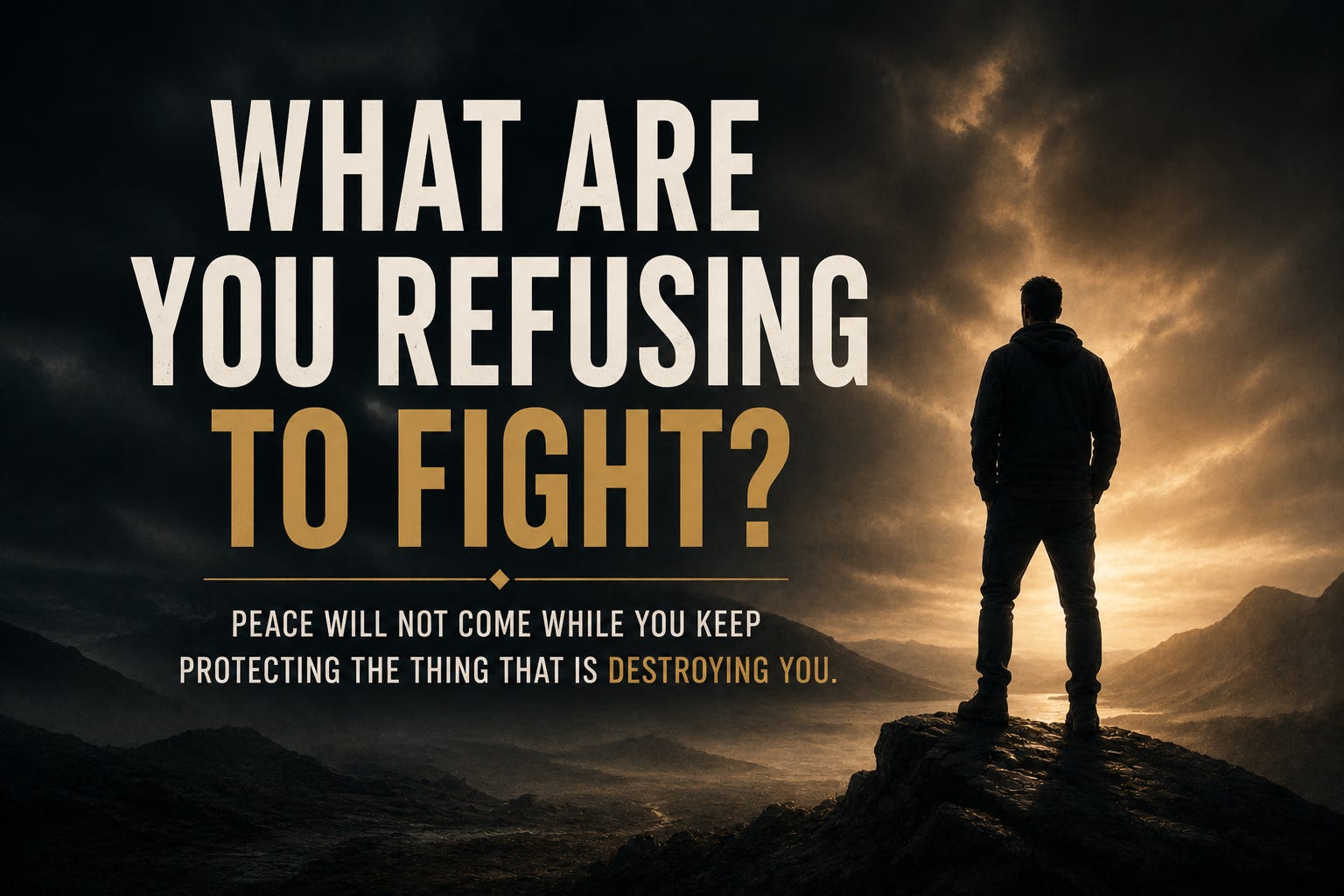
There is a line often attributed to Seneca: “Peace does not come to the man who refuses to declare war on what is destroying him.” - Seneca… maybe?
I cannot verify that Seneca wrote it. This matters for honesty, because ancient philosophers have become magnets for internet quotes they never said. A short, hard sentence appears on a black background, someone adds the name of a dead thinker underneath it, and within a week half the internet treats it like scripture.
Still, the line works. It carries a Stoic flavour even if the paper trail is weak. Seneca spent much of his writing life circling themes of discipline, fear, anger, death, appetite, self-command, and the way human beings surrender their lives to things they claim they want freedom from. The quote may be modern. The wound it points to is ancient.
Peace does not come to a man who refuses to fight what is destroying him.
That is the idea worth chewing on. However AI sounding the line may actually be.
Most people know what is destroying them. They may pretend they do not. They may soften the name. They may call it stress, a rough patch, coping, loyalty, love, ambition, habit, personality, family, bad timing, or just the way things are. Beneath all that language, they often know.
The relationship is destroying them. The drinking is destroying them. The debt is destroying them. The job is destroying them. The resentment is destroying them. The gambling is destroying them. The avoidance is destroying them. The phone is destroying them. The need to be liked is destroying them. The refusal to act is destroying them.
People often ask for peace while defending the very thing making peace impossible.
That is the strange part. They do not only tolerate the thing. They protect it. They explain it. They rationalise it. They negotiate with it. They build routines around it. They ask everyone else to understand why it has to stay. They learn how to live smaller so the thing can keep taking up space.
Then they wonder why they feel trapped. A man can spend years saying he wants peace while keeping the habit that ruins his sleep, his health, his money, his patience, his marriage, his work, or his self-respect. He may hate the consequences. He may hate the shame. He may hate waking up with the same knowledge again. Yet he still refuses to declare the thing an enemy. That refusal has a cost. You cannot make peace with something that has already declared war on you.
There are parts of life where gentleness is useful. There are wounds that need patience. There are fears that need understanding. There are patterns that deserve careful examination before they are judged. Every problem does not need to be attacked like an invading army. Some things do.
Some things do not respond to another layer of insight. Some things do not need another journal entry, another conversation, another podcast, another late-night explanation of why you are like this. Some things need a line drawn so clearly that even the weakest part of you knows the negotiation is finished. This is where people resist.
Declaring war sounds dramatic. It sounds harsh. It sounds unsophisticated to people who have been trained to make everything endlessly complex. Yet there are moments where complexity becomes a hiding place. You can analyse the thing so deeply that you never confront it. You can understand your wound so well that you start using it as permission. You can become fluent in your own destruction and still refuse to stop feeding it. The problem is loyalty to the wrong master.
A destructive habit does not always look ugly. Often it’s relief. That is why it stays. The drink calms you. The scroll distracts you. The affair makes you feel wanted. The spending gives you a moment of control. The rage gives you power. The avoidance keeps you away from shame. The toxic relationship gives you company. The self-pity gives your pain a home. Most destruction begins by offering comfort. Then it starts collecting rent.
Eventually, the thing that once helped you cope becomes the thing you now need to cope with. That is when people get trapped. The solution becomes the injury. The escape becomes the prison. The comfort becomes the thing you have to recover from.
This is why peace requires conflict. I do not mean conflict with other people as a first resort. Plenty of people are too eager for that. They want war with the ex, the boss, the parent, the government, the internet, the stranger in traffic, the person who looked at them wrong in Tesco (Or Walmart for my American friends). That kind of war can become another distraction from the harder fight.
The serious war is usually closer. It is the war against the part of you that keeps choosing the familiar wound. The part that reaches for the phone at midnight. The part that sends the message you know will tear open the injury. The part that spends money to feel alive for ten minutes. The part that calls cowardice “being realistic.” The part that keeps you waiting for a perfect moment because action would expose you to judgement.
That war is less glamorous. It does not look impressive from the outside. It looks like blocking the number. Pouring the drink away. Cancelling the subscription. Going to the appointment. Opening the letter. Telling the truth. Leaving the room. Going to bed. Getting up. Training. Apologising. Refusing the old script before it gets its hands around your throat again.
People want the cinematic version of change. They imagine transformation as a single clean decision where the music swells and the old life falls away. Real change is usually uglier. It is repetitive, boring, humiliating, and full of moments where the part of you that wants freedom has to overpower the part of you that wants relief. That is war.
You do not win it by hating yourself. Self-hatred is usually another form of collapse. It burns energy. The goal is not to despise the part of you that learned to survive through damaging things. There is a difference between understanding why something began and giving it permanent authority over your life. You may have good reasons for the pattern. You may have history. You may have trauma. You may have grief, abandonment, humiliation, fear, loneliness, poverty, pain, or years of being trained into the wrong response. All of that may explain why the thing got in. It does not prove it gets to stay.
A person can understand the roots of their anger and still need to stop using anger as a weapon. A person can understand the loneliness behind their drinking and still need to stop drinking. A person can understand the fear behind their avoidance and still need to act. A person can understand the wound behind their attachment and still need to stop chasing people who keep tearing it open.
Understanding is valuable. Understanding without action is simply torturing yourself. Peace is not the reward for endlessly explaining yourself. Peace comes when the conditions creating chaos begin to lose power. Sometimes that means changing your environment. Sometimes it means leaving. Sometimes it means discipline. Sometimes it means treatment. Sometimes it means accountability. Sometimes it means grief. Sometimes it means admitting that the thing you keep calling complicated is simply costing too much.
Ask the question. What is destroying me? Do not dress the answer up. Do not make it sound clever. Do not round the edges off so your pride can survive the sentence. Name it with enough accuracy that your life has something specific to confront. Then ask the next question. What am I still doing that protects it? Everyone likes naming the enemy when the enemy is external. Fewer people enjoy noticing the ways they feed it. The excuses. The secrecy. The half-truths. The routines. The people who enable it. The environments that keep it alive. The little permissions. The “one last time” agreements you keep signing with your own destruction. Peace requires you to become harder to negotiate with.
The old pattern knows your arguments before you make them. It knows your weak hours. It knows which emotions open the door. It knows how to sound reasonable. It knows how to turn one exception into a relapse, one conversation into a reunion, one drink into a weekend, one scroll into three hours, one compromise into another year lost.
You need rules for the version of you that appears when your conviction drops. That is not weakness. That is strategy. If you know you collapse at night, do not leave the decision until night. If you know you spend when you are ashamed, remove the easy route to spending. If you know you text them when you feel abandoned, make contact harder before the feeling arrives. If you know you avoid hard conversations, put the conversation in the calendar. If you know you lie to yourself when you are tired, stop trusting tired thoughts as moral guidance. A declaration of war is not a mood. It is a structure.
It is the point where you stop relying on motivation and start building barriers between yourself and the thing that keeps winning. It is the point where you stop treating every urge as a vote. It is the point where you stop mistaking intensity for truth. Peace has to be defended. They want peace, as rest, as relief. Sometimes it does. More often, peace begins as an act of aggression against the chaos you have allowed to become normal. You may have to disappoint people who benefited from your lack of boundaries. You may have to become less available to habits that made you easy to manage. You may have to lose the identity that came with being endlessly tolerant, endlessly understanding, endlessly forgiving, endlessly tired. You may have to let the old version of yourself accuse you of betrayal while the new one learns how to breathe.
Peace is expensive at the beginning because chaos usually gave you something. That is why the war is difficult. You are not only losing the damage. You are losing the comfort that came attached to it. The relationship gave you closeness. The habit gave you relief. The anger gave you certainty. The avoidance gave you safety. The fantasy gave you somewhere to escape. The identity gave you a role. Freedom often begins with withdrawal.
People want the clean victory, not the shaking hands. They want the new life, not the empty space where the old poison used to sit. Yet that empty space is where peace starts becoming possible. It will feel wrong at first because destruction often becomes familiar like home.
Do not confuse familiar with safe. A lot of people stay loyal to what is destroying them because they are frightened of who they would be without it. That is a serious fear. Some habits, relationships, roles, and stories become load-bearing walls in a life. Remove them and the whole structure feels unstable. That does not mean the wall belongs there. It may mean the house has been built around damage for too long.
So rebuild carefully. Get help where needed. Use support. Use faith if faith is part of your life. Use therapy if therapy is available. Use structure, routine, training, accountability, friendship, distance, silence, prayer, work, whatever gives your better judgement a stronger grip. Just stop calling surrender peace. If something is destroying you, peace will not come from making it more comfortable. Peace will not come from understanding it forever. Peace will not come from asking it politely to take a little less next time.
Name it. Face it. Remove its privileges. Build a life where it has less access to you. The line may not be Seneca’s. The demand is still real. Peace does not come to the man who refuses to declare war on what is destroying him. At some point, the thing has to be named, opposed, starved, blocked, left, buried, or outgrown.
You do not need to hate yourself to fight for yourself. You only need to decide that the thing destroying you has had enough of your life.
Further reading
These sources are useful starting points for readers who want to understand Seneca, Stoicism, self-command, destructive patterns, and the practical discipline of changing what keeps damaging a life.
Seneca. (2004). Letters from a Stoic (R. Campbell, Trans.). Penguin Classics.
Seneca. (2010). On the shortness of life: Life is long if you know how to use it (C. D. N. Costa, Trans.). Penguin Classics.
Vogt, K. (2022). Seneca. In E. N. Zalta & U. Nodelman (Eds.), The Stanford encyclopedia of philosophy. https://plato.stanford.edu/entries/seneca/
Internet Encyclopedia of Philosophy. (n.d.). Seneca, Lucius Annaeus. https://iep.utm.edu/seneca/
This is the surface of the work.
If you want the part that speaks directly to where you are,
my Letters to the Lost are written for that.
This is a powerful piece. What I appreciated most is that you did not romanticise change as something clean, simple, or instantly liberating. You named the uncomfortable truth that many of the things destroying us once gave us something we desperately needed: relief, familiarity, belonging, distraction, control, or a place to put our pain.
That line — “Most destruction begins by offering comfort. Then it starts collecting rent” — really stayed with me. It captures the heartbreak of so many coping mechanisms, relationships, and survival patterns. They do not always begin as enemies. Sometimes they begin as shelter. But eventually, we have to ask whether the thing that helped us survive one season is now quietly stealing the life we are trying to build.
I also deeply appreciated the distinction between understanding a pattern and giving it permanent authority. Compassion matters. Context matters. Trauma, grief, loneliness, fear, and conditioning matter. But as you said so clearly, explanation is not the same as liberation. At some point, understanding has to become protection. We have to stop negotiating with what keeps wounding us.
What feels especially important here is that this is not a call to self-hatred. It is a call to self-respect. Not “fight yourself because you are broken,” but “fight for yourself because your life is worth defending.” That is such a necessary reframe.
This piece made me think about how peace is not always soft at first. Sometimes peace begins with a boundary, a blocked number, an honest admission, a difficult ending, or the first small refusal to keep feeding the old pattern. Sometimes the most compassionate thing we can do for ourselves is to become unavailable to our own destruction.
Thank you for writing this with such clarity and force. It is confronting, but in a way that feels deeply necessary.
This is the truth and very insightful, thank you for opening our eyes!