
You’ve Understood Your Trauma. Now What?
You already know what needs doing.

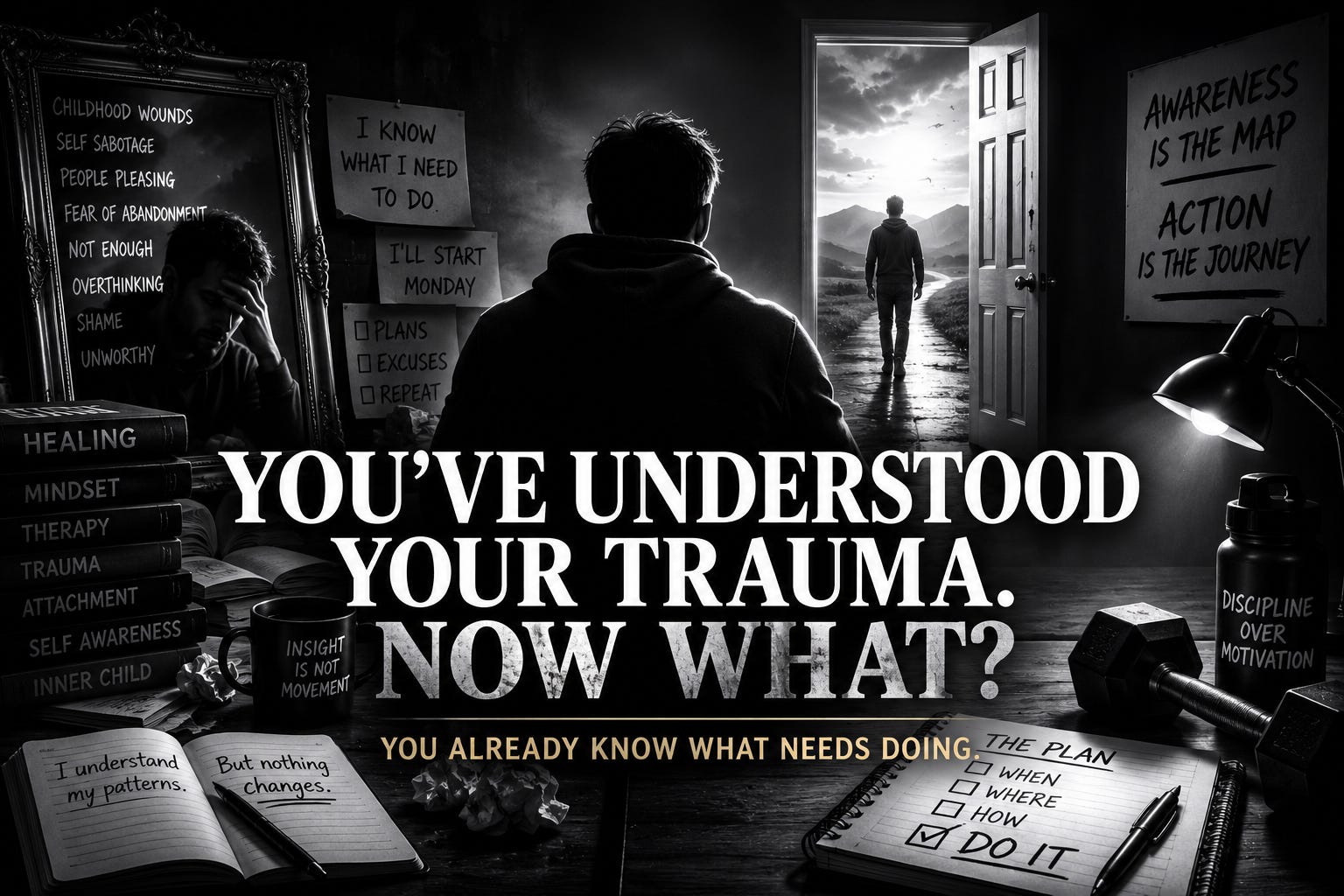
That is not the issue. You know you need to exercise. You know the relationship is damaging. You know you spend too much. You know the habit is costing you. You know what needs to be said. You have known for a while now, and yet here you are, still in the same place, carrying the same unacted-on knowledge like luggage you keep dragging through airports but never actually unpack.
This is one of the most uncomfortable truths in psychology, and almost nobody blurts out the quiet thing out loud. Knowing is not doing. Understanding your pattern does not break it. They feel related. They feel like the same thing. They are not even close.
The self-help industry has built an empire on the wrong premise. Read this book. Watch this video. Listen to this podcast. Understand yourself more deeply. And people do. They consume. They highlight. They nod along. They feel the brief warmth of recognition, “yes, that is me, that is exactly what I do,” and they walk away feeling like something has shifted. It hasn’t. Recognition is not movement. You spend enough time screaming at a glowing screen, warning characters about the killer in the next room, fully aware nothing you say will change what happens next. You do the same thing with your own life. You see the problem. You know exactly what is coming. And you sit there anyway, as if the script has already been written and you forgot you are holding the pen.
Webb and Sheeran put a number on it: even when you successfully change what someone intends to do, the resulting change in their actual behaviour is substantially smaller. Intentions predict behaviour far less than people assume. The gap between meaning to and actually doing is not a minor administrative detail. It is where most of the wreckage is.
Think about the people you know. Think about yourself. How many things do you fully understand and still do not change? You understand why you self-sabotage. You have probably even traced it back to something, a parent, a wound, a pattern laid down early. That understanding can be genuinely useful. But it does not do the work for you. Nobody’s therapist ever said “well, you understand it now, so you’re fixed.” Understanding is the map. You still have to walk the road. Knowing your phone battery is low is not the same as sticking it on charge now, is it?
People mistake the feeling of insight for the act of progress. They journal about their patterns. They discuss their childhood. They label their attachment style. They identify their cognitive distortions. And then they go home and repeat the same behaviour, because none of that activity was actually doing the thing. It was understanding the thing. Comfortable. Interesting. Safe.
Gollwitzer’s work on implementation intentions makes this concrete. Vague goals collapse. People who intend to change without deciding “when, where, and how” tend not to follow through. The ones who do follow through are the ones who get specific enough that the intention becomes almost mechanical. Not “I want to get fit” but “I am going to walk for thirty minutes on Monday, Wednesday, and Friday at seven in the morning before I make excuses.” The specificity is not a small detail. It is the whole thing. Insight tells you what you want to change. The plan is what actually changes it.
Bandura spent decades making this same argument from a different angle. Self-efficacy, your belief in your own capacity to act, is the engine. Not knowledge of the problem. Not awareness of the pattern. The belief that your action will produce a result, combined with the actual decision to act, is what moves the needle. Insight without that belief just gives you a more articulate vocabulary for describing your own stuckness.
And passive understanding alone, simply receiving information about yourself, produces modest effects at best. The research on psychoeducation shows this clearly. Being told about your condition is useful. It is not sufficient. The active ingredient is always the behaviour that follows.
So what do you do with this?
You stop treating understanding as if you have achieved enlightenment. Treat it as the first cog in a much more complex machine. The first glance at a path that has finally been lit for you. Now tentatively step onto it. Ask yourself not “why do I do this” but “what am I going to do differently and when.” Stop allowing insight to become a substitute for action. Stop letting self-awareness be the performance that replaces the work.
You already know what needs doing.
That was never the problem.
The problem is that knowing something and living differently are two entirely separate decisions, and most people only ever make the first one.
Make the second one.
Further reading
The ideas in this article are grounded in research on the intention–behaviour gap, implementation intentions, self-efficacy, and the limits of psychoeducation as a standalone intervention. These are the strongest places to start.
Bandura, A. (2004). Health promotion by social cognitive means. “Health Education & Behavior”, “31”(2), 143–164. https://doi.org/10.1177/1090198104263660
Donker, T., Griffiths, K. M., Cuijpers, P., & Christensen, H. (2009). Psychoeducation for depression, anxiety and psychological distress: A meta-analysis. “BMC Medicine”, “7”(1), Article 79. https://doi.org/10.1186/1741-7015-7-79
Gollwitzer, P. M. (1999). Implementation intentions: Strong effects of simple plans. “American Psychologist”, “54”(7), 493–503. https://doi.org/10.1037/0003-066X.54.7.493
Gollwitzer, P. M., & Sheeran, P. (2006). Implementation intentions and goal achievement: A meta-analysis of effects and processes. “Advances in Experimental Social Psychology”, “38”, 69–119. https://doi.org/10.1016/S0065-2601(06)38002-1
Sheeran, P., & Webb, T. L. (2016). The intention–behaviour gap. “Social and Personality Psychology Compass”, “10”(9), 503–518. https://doi.org/10.1111/spc3.12265
Webb, T. L., & Sheeran, P. (2006). Does changing behavioral intentions engender behavior change? A meta-analysis of the experimental evidence. “Psychological Bulletin”, “132”(2), 249–268. https://doi.org/10.1037/0033-2909.132.2.249
This is the surface of the work.
If you want the part that speaks directly to where you are,
my Letters to the Lost are written for that.
This topic began on my radio show, Mind Your Motor, where I talk through mental health, psychology, and everyday life in plain language. The show is live on Tuesdays at 7pm UK on BHP Radio, and you can talk to me directly during the show through the shoutbox at bhpradio.com/shoutbox.